Clip Art of Girl Shoplifting Free Black and White Clip Art of Court Proceedings

A person in a store slipping an particular into their pocket
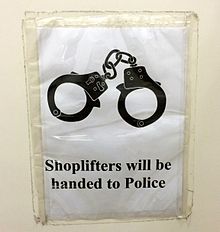
Notice warning shoplifters of prosecution in Subang Parade, Malaysia
Shoplifting is the theft of goods from an open retail institution, typically by concealing a shop item on one's person, in pockets, under dress, or in a pocketbook, and leaving the shop without paying. With wearable, shoplifters may put on items from the store and go out the store wearing the clothes. The terms "shoplifting" and "shoplifter" are not unremarkably defined in law. The law-breaking of shoplifting more often than not falls nether the legal classification of larceny. Shoplifting is singled-out from burglary (theft by breaking into a airtight shop), robbery (stealing by threatening or engaging in tearing behavior), or armed robbery (stealing by using a weapon). In the retail industry, the word "shrinkage" (or "compress") can be used to refer to merchandise lost past shoplifting, but the discussion also includes loss by other means, such as waste, uninsured damage to products, and theft by shop employees.
Shoplifters range from amateurs acting on impulse, to career criminals who habitually appoint in shoplifting as a form of income. Career criminals may use several individuals to shoplift, with some participants distracting store employees while another participant steals items. Amateurs typically steal products for personal utilise, while career criminals generally steal items to resell them in the underground economy. Other forms of shoplifting include swapping cost labels of different items, return fraud, or eating a grocery store's nutrient without paying for it. Commonly shoplifted items are those with a loftier cost in proportion to their size, such as dispensable razor blades, vitamins, alcoholic beverages, and cigarettes.
Stores use a number of strategies to reduce shoplifting, including storing small, expensive items in locked glass cases; chaining or otherwise attaching items to shelves or wearing apparel racks (particularly expensive items); attaching magnetic or radio sensors or dyepacks to items; installing curved mirrors mounted above shelves or video cameras and video monitors, hiring plainclothes "store detectives" and security guards, and banning the bringing in of backpacks or other bags. Some stores take security guards at the exit, who search backpacks and bags and check receipts. Stores also gainsay shoplifting past training employees how to detect potential shoplifters.
The outset documented shoplifting started to take place in 16th century London. By the early 19th century, shoplifting was believed to be primarily a female person action. In the 1960s, shoplifting began to exist redefined again, this time every bit a political act. Researchers divide shoplifters into two categories: "boosters" (professionals who resell what they steal), and "snitches" (amateurs who steal for their personal use).[i]
Definition [edit]
Shoplifting is the act of knowingly taking goods from an establishment in which they are displayed for sale, without paying for them. Shoplifting usually involves concealing items on the person or an cohort, and leaving the shop without paying. However, shoplifting can besides include cost switching (swapping the toll labels of different goods), refund fraud, and "grazing" (eating or sampling a store's goods while in the store). Price switching is now an well-nigh extinct form of shoplifting for two reasons. Beginning, the labels will split autonomously upon attempted removal, and 2d, virtually all retail cashiers now browse items at the register, rather than relying on cost stickers. Retailers written report that shoplifting has a significant consequence on their lesser line, stating that nearly 0.half-dozen% of all inventory disappears to shoplifters.[ citation needed ]
More often than not, criminal theft involves taking possession of property illegally. In self-service shops, customers are allowed by the belongings owner to take concrete possession of the property by holding or moving it. This leaves areas of ambivalence that could criminalize some people for simple mistakes, such as accidental putting of a minor detail in a pocket or forgetting to pay. For this reason penalties for shoplifting are often lower than those for general theft. Few jurisdictions have specific shoplifting legislation with which to differentiate it from other forms of theft, so reduced penalties are usually at a judge'southward discretion. Most retailers are aware of the serious consequences of making a fake abort, and will only attempt to auscultate a person if their guilt is beyond a reasonable doubt. Depending on local laws, arrests fabricated by anyone other than law enforcement officers may also be illegal.[ citation needed ]
Types of individuals [edit]
Amateurs [edit]
Some shoplifters are amateurs who do not steal regularly from stores and who exercise non use shoplifting as a form of income (east.m., past reselling stolen goods). Researchers call these amateurs "snitches", as they are stealing items for their personal apply.[1] In several countries, criminal flash mobs, primarily fabricated up of teenagers and young adults, enter stores with the intention of stealing merchandise while accomplices distract staff.[two]
Career criminals [edit]
Withal, there are people and groups who make their living from shoplifting and other crimes. They tend to be more skilled career criminals who use more sophisticated shoplifting tactics. Researchers telephone call professional thieves "boosters", as they tend to resell what they steal[ane] on the black market.
Legal definitions [edit]
Shoplifting is considered a class of theft and is subject area to prosecution. In the United Kingdom, theft is divers equally "dishonestly appropriate[ing] property belonging to another with the intention of permanently depriving the other of it; and "thief" and "steal" shall be construed accordingly."[iii] It is one of the most common crimes.[4] Shoplifting peaks between 3:00 and iv:00 p.m., and is everyman from 6:00 a.g. to vii:00 a.m.[5] In the United States, shoplifting increases during the Christmas season, and arrest rates increment during bound break.[vi] Rutgers University criminologist Ronald 5. Clarke says shoplifters steal "hot products" that are "CRAVED", an acronym he created that stands for "concealable, removable, available, fivealuable, enjoyable, and disposable".[seven]
Mutual items [edit]
The nigh commonly shoplifted item used to be cigarettes, until stores started keeping them backside the cash register. Normally shoplifted items are commonly pocket-sized and easy to hide, such as groceries, especially steak and instant coffee, razor blades and cartridges, small-scale applied science items such as MP3 players, smartphones, USB flash drives, earphones, CDs and DVDs, gift cards, cosmetics, jewelry, multivitamins, pregnancy tests, electric toothbrushes, and wearable.[8] [9] [10]
In the The states, frequently shoplifted books include ones by authors Charles Bukowski, Jim Thompson, Philip Chiliad. Dick, Martin Amis, Paul Auster, Georges Bataille, William S. Burroughs, Hunter S. Thompson, Italo Calvino, Don DeLillo, Raymond Chandler, Michel Foucault, Dashiell Hammett, Jack Kerouac and other Beat Generation writers, Jeanette Winterson, Chuck Palahniuk, Haruki Murakami, Jeffrey Eugenides, and Mark Z. Danielewski.[11] [12] [13] [fourteen] [15] (See Book store shoplifting.)
Economist perspectives [edit]
Economists say shoplifting is mutual considering it is a relatively unskilled crime with depression entry barriers that can be fitted into a normal lifestyle. People of every nation, race, ethnicity, gender, and social form shoplift. Originally, assay of information almost apprehended shoplifters and interviews with store detectives suggested that females were about twice as likely every bit males to shoplift. Even so, since 1980, the data advise that males are equally or more probable to shoplift than females. The average shoplifter outset did it at the age of x: shoplifting tends to summit in boyhood so steadily declines thereafter. People of all races shoplift every bit, and poor people shoplift just slightly more rich people.[8] Men tend to shoplift using bags, and women using strollers.[16] [17] When defenseless, a shoplifter has on average $200 worth of unpaid merchandise.[18]
Methods [edit]
Concealing [edit]
Shoplifters may conceal items in their pockets, under their clothes, in numberless, or in a personal item they are carrying (for example, a box) or pushing (for example, a stroller) or, if at a shopping center/mall, a bag from another store in that center. The utilize of backpacks and other bags to shoplift has led some stores to non allow people with backpacks in the store, frequently by asking the person to leave their haversack at a store counter.[ citation needed ] With clothes, shoplifters may put on the store wear underneath their ain apparel and exit the store.
Walkout/pushout [edit]
Some shoppers fill a shopping cart with unconcealed merchandise, and walk out of the store without paying. Security workers call that method "walkout" or "pushout".[nineteen] With clothing, some shoplifters may simply put on a coat or jacket from the store and walk out wearing the item. This tactic is used because busy employees may only not notice a person pushing a cart out without paying or walking out wearing a store-owned coat. Some "pushout" shoplifters purposefully exit quickly to avoid detection, equally this gives employees less time to react.
Many stores instruct employees other than those directly involved in theft prevention or security to confront someone only verbally to avoid whatsoever possibility of being held liable for injury or unwarranted detention. While that may permit stolen appurtenances to not be recovered, the loss of acquirement may exist judged to be acceptable in lite of the cost of a potential lawsuit or an employee being injured by a fleeing shoplifter.
History [edit]
Shoplifting, originally chosen "lifting", is as old equally shopping. The first documented shoplifting started to take place in 16th-century London, and was carried out by groups of men chosen lifters. In 1591, playwright Robert Greene published a pamphlet titled The Second Role of Cony Catching, in which he described how iii men could conspire to shoplift clothes and textile from London merchants. When it was first documented, shoplifting was characterized as an underworld practice: shoplifters were also con artists, pickpockets, pimps, or prostitutes.[xx] [21]
In the late 17th century, London shopkeepers began to display appurtenances in ways designed to attract shoppers, such as in window displays and glass cases. This made the goods more attainable for shoppers to handle and examine, which historians say led to an acceleration of shoplifting.[22]
The word shoplift (then, shop-lift) get-go appeared at the finish of the 17th century in books similar The Ladies Dictionary, which, as well equally describing shoplifting, provided tips on losing weight and styling pilus.[23] Female shoplifters of this menses were also chosen "Amazons" or "roaring girl". Notorious female shoplifters in London included Mary Frith, the pickpocket and fence also known equally Moll Cutpurse, pickpocket Moll Rex, Sarah McCabe whose shoplifting career spanned 20 years, and Maria Carlston (besides known as Mary Blacke), whose life was documented past diarist Samuel Pepys, who was eventually executed for theft, and who for years shoplifted article of clothing and household linens in London with one or more female accomplices.[xvi] [xx]
In 1699, the English Parliament passed The Shoplifting Act, role of the Bloody Code that punished petty crimes with death. People bedevilled of shoplifting items worth more 5 shillings would exist hanged in London's Tyburn Tree (known as the "Tyburn jig") with crowds of thousands watching, or would be transported to the N American colonies or to Phytology Bay in Australia. Some merchants establish The Shoplifting Act overly severe, jurors ofttimes deliberately under-valued the cost of items stolen then bedevilled shoplifters would escape expiry, and reformist lawyers advocated for the Act'southward repeal, but The Shoplifting Act was supported by powerful people such equally Lord Ellenborough, who characterized penal transportation as "a summer ambulation to a milder climate" and the archbishop of Canterbury, who believed that strong penalization was necessary to prevent a dramatic increase in criminal offense. As England began to embrace Enlightenment ideas nigh crime and punishment in the 18th century, opposition to the Bloody Code began to grow. The last English language execution for shoplifting was carried out in 1822, and in 1832 the House of Lords reclassified shoplifting as a non-capital crime.[24]
Past the early 19th century, shoplifting was believed to be primarily a female activeness,[25] and doctors began to redefine some shoplifting as what Swiss medico André Matthey had and so newly christened "klopemania" (kleptomania), from the Greek words "kleptein" (stealing) and "mania" (insanity). Kleptomania was primarily attributed to wealthy and middle-class women, and in 1896 was criticized by anarchist Emma Goldman as a manner for the rich to excuse their own class from penalty, while continuing to punish the poor for the same acts.[26] [27]
In the 1960s, shoplifting began to be redefined again, this fourth dimension as a political act. In his 1970 book Do It: Scenarios of the Revolution, American activist Jerry Rubin wrote "All coin represents theft...shoplifting gets you high. Don't purchase. Steal," and in The Agitator Cookbook, published in 1971, American author William Powell offered tips for how to shoplift. In his 1971 book Steal This Volume, American activist Abbie Hoffman offered tips on how to shoplift and argued that shoplifting is anti-corporate. In her volume The Steal: A Cultural History of Shoplifting, social historian Rachel Shteir described how shoplifting from companies you dislike is considered by some activist groups, such as some freegans, decentralized anarchist collective CrimethInc, the Castilian anarchist collective Yomango and the Canadian magazine Adbusters, to be a morally defensible deed of corporate sabotage.[28] [29] [30] [31]
Motivations [edit]
Researchers separate shoplifters into ii categories: "boosters", professionals who resell what they steal, and "snitches", amateurs who steal items for their personal use.[1] Motivations for shoplifting are controversial among researchers, although they generally agree that shoplifters are driven by either economical or psychosocial motives. Psychosocial motivations may include peer pressure, a want for thrill or excitement, impulse, stealing because judgment is clouded by intoxication, or doing so considering of a compulsion.[8] Low is the psychiatric disorder most commonly associated with shoplifting. Shoplifting is also associated with family unit or marital stress, social isolation, having had a difficult childhood, alcoholism or drug employ, low self-esteem, and eating disorders, with bulimic shoplifters ofttimes stealing nutrient. Some researchers have theorized that shoplifting is an unconscious attempt to brand upward for a by loss.[32]
Researchers have plant that the conclusion to shoplift is associated with pro-shoplifting attitudes, social factors, opportunities for shoplifting and the perception that the shoplifter is unlikely to be caught. Researchers say that shoplifters justify their shoplifting through a multifariousness of personal narratives, such as assertive they are making up for having been victimized, that they are unfairly existence denied things they deserve, or that the retailers they steal from are untrustworthy or immoral.[32] Sociologists call these narratives neutralizations, meaning mechanisms people apply to silence values within themselves that would otherwise foreclose them from carrying out a particular act.
A 1984 program in W Texas designed to reduce recidivism (repeat offenses) amongst convicted adult shoplifters identified 8 common beliefs of shoplifters:
- If I am careful and smart, I will not get caught.
- Even if I practice get caught, I will not be turned in and prosecuted.
- Even if I am prosecuted, the punishment volition not be severe.
- The merchants deserve what they become.
- Everybody, at some time or some other, has shoplifted; therefore it'southward OK for me to do.
- Shoplifting is not a major crime.
- I must have the item I want to shoplift or if I want information technology, I should have information technology.
- It is okay to shoplift considering the merchants look it.[33]
Developmental psychologists believe that children under the age of ix shoplift to exam boundaries, and that tweens and teenagers shoplift mainly for excitement or the thrill, are "acting out" (or depressed), or are being pressured by their peers.[17]
Differences past geography [edit]
Researches say that around the world, in countries including the Usa, Canada, Australia, Brazil, United mexican states, Due south Africa, Japan, and India, people tend to shoplift the same types of items, and oft even the same brands.[34]
But there are also differences in shoplifting among different countries that reverberate those countries' general consumption habits and preferences. In Milan, saffron, an expensive component of risotto alla Milanese, is often shoplifted, and throughout Italy, parmigiano reggiano is oftentimes stolen from supermarkets. In Spain, jamón ibérico is a frequent target. In France, the anise-flavoured liqueur ricard is oftentimes stolen, and in Nihon, experts believe that manga comics, electronic games and whisky are nigh frequently stolen. Bookstores and magazine sellers in Nippon accept also complained about what they call "digital shoplifting", which refers to the photographing of material in-store for later reading. Packaged cheese has been the most oft shoplifted item in Norway, with thieves selling it afterwards to pizza parlours and fast food restaurants.[34]
Economical impact and response from shops [edit]
According to a report from Tyco Retail Solutions, the global retail industry lost an estimated $34 billion in sales in 2017 to shoplifting, which is approximately ii per centum of full revenue. Shoplifting is the largest single reason for loss of merchandise.[35]
Retailers report that shoplifting has a pregnant effect on their bottom line, stating that near 0.6% of all inventory disappears to shoplifters. According to the 2012 National Retail Security Survey, shoplifting costs American retailers approximately $14B annually.[36] In 2001, it was claimed that shoplifting cost U.s.a. retailers $25 million a day. Observers believe that manufacture shoplifting numbers are over half employee theft or fraud and the balance by patrons. Of class, if apprehended during the shoplifting the merchandise is generally recovered by the retailers and there is oft no loss to the store possessor when the merchandise is surrendered to the store past the suspects. In addition, in many states retailers have the right to recover civil damages to cover the cost of providing security.
According to a December 23, 2008, article in the Pittsburgh Mail service-Gazette, Dimperio's Market, the only full-service grocery shop in the Hazelwood neighborhood of Pittsburgh, Pennsylvania, closed because of shoplifters.[37] Walgreens reported that it closed 10 stores in the San Francisco expanse betwixt 2019 and 2020, primarily due to a surge in theft.[38] [39]
Consequences [edit]
Shoplifting is considered a form of theft and is subject to prosecution. Retailers may also ban from their premises individuals who have shoplifted from stores.
The states [edit]
In most cases in the United States, store employees and managers accept certain powers of arrest. Shop officials may detain for investigation (for a reasonable length of time), the person who they have likely crusade to believe is attempting to have or has unlawfully taken merchandise (see shopkeeper's privilege). Store employees may also take denizen's abort powers,[40] but absent-minded a statute granting broader authority a citizen'south abort power is usually available merely for felony offenses, while shoplifting is unremarkably a misdemeanor law-breaking.[41]
In the United States, store employees who detain suspects outside of and inside the store premises are generally granted limited powers of abort by state police, and have the power to initiate criminal arrests or civil sanctions, or both, depending upon the policy of the retailer and the state statutes governing civil demands and ceremonious recovery for shoplifting equally reconciled with the criminal laws of the jurisdiction.[42] [43] [44]
England and Wales [edit]
In England and Wales, an offence involving shoplifting may exist charged under Section 1 of the Theft Act 1986; alternatively, if the goods stolen are worth less than £200, a person may be charged nether Department 176 of the Anti-Social Behaviour, Law-breaking and Policing Act. Upon conviction, the maximum penalty is a fine or up to 6 months in prison if the goods stolen are worth less than £200; if they are worth more than £200, the maximum punishment is seven years in prison.[45]
Centre Eastward [edit]
In the Islamic legal arrangement called Sharia, "hudud" (meaning limits or restrictions) calls for "Sariqa" (theft) to be punished by amputation of the thief's paw. This punishment is categorized as "hadd", meaning a punishment that restrains or prevents further crime. Sariqa is interpreted differently in different countries and by different scholars, and some say information technology does non include shoplifting.[46] [47] [48] But, in Saudi Arabia shoplifters' hands may be amputated.[49] [50]
Prevention [edit]
Shoplifting may exist prevented and detected. Closed-circuit television (CCTV) monitoring is an important anti-shoplifting technology. Electronic commodity surveillance (EAS) is another method of inventory protection. Radio-frequency identification (RFID) is an anti-employee-theft and anti-shoplifting technology used in retailers such as Walmart, which already heavily use RFID technology for inventory purposes. Loss prevention personnel can consist of both uniformed officers and plain-clothed store detectives. Large section stores volition use both and smaller stores will utilize i or the other depending on their shrink strategy. Shop detectives will patrol the store interim as if they are existent shoppers. Physical measures include implementing a i-mode entry and exit arrangement, protected with devices such as "shark teeth" gates to ensure trolleys can but pass through one way.[51]
The presence of uniformed officers acts every bit a deterrent to shoplifting activity and they are mostly used by high-end retail establishments. Shoppers in some stores are asked when leaving the bounds to have their purchases checked against the receipt. Some expensive merchandise volition be in a locked case requiring an employee to get items at a customer's request. The customer is required to purchase the merchandise immediately, or it is left at the checkout expanse for the customer to purchase when finishing shopping. Many stores also lock CDs, DVDs, and video games in locking cases, which can just exist opened past the checkout operator once the item has gone through the checkout. Some stores will utilize dummy cases, as well known every bit "dead boxes", in which the box or case on the shelf is entirely empty and the customer volition not be given the detail they accept paid for until the transaction has been completed, usually by other store staff.
Security guards are generally given the following criteria that must be met before acumen a shoplifting suspect:[52]
- You must come across the shoplifter arroyo the merchandise; select the merchandise; and muffle, catechumen or carry abroad the merchandise.
- Yous must maintain continuous observation of the shoplifter.
- You lot must notice the shoplifter leave the store and fail to pay for the trade.
- Yous must apprehend the shoplifter exterior the store.
Many stores will put up signs warning almost the consequences of shoplifting or signs warning about the use of surveillance cameras in the store. That is intended to deter people from trying to shoplift.
Airtight-excursion television [edit]
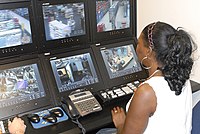
A security baby-sit watches a store's CCTV cameras.
Closed-circuit television (CCTV) monitoring is an important anti-shoplifting applied science. Retailers focusing on loss prevention often devote almost of their resources to this technology. Using CCTVs to apprehend shoplifters in the act requires full-time human monitoring of the cameras. Sophisticated CCTV systems discriminate the scenes to detect and segregate suspicious behaviour from numerous screens and to enable automated alerting. However, the attentiveness of the surveillance personnel may be threatened by false reliance on automatics. CCTV is more effective if used in conjunction with electronic commodity surveillance (EAS) systems. The EAS system will warn of a potential shoplifter and the video may provide evidence for prosecution if the shoplifter is allowed to laissez passer checkout points or leave store premises with unbought merchandise.
Many stores will use public-view monitors in the store to show people in that location that they are being recorded. That is intended as a deterrent to shoplifting. Some stores use inexpensive dummy cameras. Fifty-fifty though these faux cameras cannot record images, their presence may deter shoplifting.
Electronic commodity surveillance [edit]
Electronic article surveillance (EAS) are magnetic or radio-frequency tags that sound an alarm if a shoplifter leaves a shop with store items that have not been paid for. EAS methods are second only to CCTV in popularity amongst retailers looking for inventory protection.[53] EAS refers to the electronic security tags that are attached to trade and cause an alarm to sound on exiting the store. Some stores too have detection systems at the entrance to the bathrooms that sound an warning if someone tries to take unpaid merchandise with them into the bathroom. Regularly, even when an alarm does sound, a shoplifter walks out casually and is not confronted if no guards are present because of the high number of false alarms, especially in malls, due to "tag pollution" whereby non-deactivated tags from other stores prepare off the warning. This tin can be overcome with newer systems and a properly trained staff. Some new systems either do not alarm from "tag pollution" or they produce a specific alarm when a customer enters the shop with a not-deactivated tag so that store personnel tin remove or deactivate information technology and so information technology does not produce a false warning when exiting the store. However, spider wrap may be used instead of tags.

Some tags are stuck onto trade with glue (rather than being superimposed on) the shoplifter can easily scrape off the tag in their pocket. Pedestal EAS covers, which are made of durable vinyl, offer toll-constructive ways of adding a marketing tool at every entrance to a store; they are likewise custom-manufactured to fit any pedestal and can be printed to highlight specific brands or seasonal promotions. They practice not interfere with the functioning of the EAS systems and are easily cleaned or changed.[54] Some shoplifters may apply jammer devices to preclude EAS tags from triggering, or magnets to remove the tags. Stores may employ engineering science to detect jammers and magnets.
Radio-frequency identification (RFID) is an anti-employee-theft and anti-shoplifting engineering used in retailers such every bit Walmart, which already heavily use RFID technology for inventory purposes. If a product with an active RFID tag passes the exit scanners at a Walmart outlet, not only does it fix off an alarm, only it likewise tells security personnel exactly what product to expect for in the shopper's cart.[55]
Add-on metal detector systems will be used in some stores with electronic article surveillance which sense metallic surfaces. They are used to deter the use of booster bags which are used to shield EAS tags.
Staff roles [edit]

A British shop owner using a two-style radio to remain in contact with police, an approach that police force enforcement officers hope will reduce shoplifting.
Store detectives tin can patrol the store wearing plainclothes and act as if they are existent shoppers. They may browse, examine, carry, or even try on merchandise, while looking for signs of shoplifting and looking for possible shoplifters. Many large retail companies use that technique. Shop detectives will watch a shoplifting suspect conceal an item, then stop them later they have exited the store. Those types of personnel must follow a strict set of rules because of very high liability risks. Many large retail or grocery stores have a store detective to watch for shoplifters. Near of those stores use hush-hush verbal codes over the PA system to alert direction, other loss prevention personal, and associates that there is a shoplifter. Store detectives must follow a doubtable around the shop by foot or by watching video monitors and discover every move the person makes so that they practice not face a lawsuit for apprehending or arresting the wrong person.
The presence of uniformed security guards acts every bit a deterrent to shoplifting activity. Guards are mostly used by high-stop retail establishments such as jewellery stores and camera and electronics stores, but are as well used by other retailers. Floor attendants greet customers, follow them as they walk virtually the store, and offer help with shopping. Shoplifters are non comfortable with this attention and may get somewhere else where they can steal unnoticed. In a 2008 global study conducted by NRMA, it found shoplifters are 68 percent less probable to commit the crime if they are greeted immediately as they walk into the retail store.
Some stores have an employee work at the fitting rooms. The employee will count how many clothes a person brings into the fitting rooms and ensure that they come up out with the same number of clothes. This is to forestall people from using the fitting rooms to shoplift.
Leave inspections [edit]
Shoppers in some stores are asked when leaving the bounds to have their purchases checked against the receipt. Costco and All-time Buy are companies that employ this tactic. However, that is voluntary, as the store cannot legally detain the shopper unless they have likely cause to suspect the shopper of shoplifting.
In the The states, shoppers are nether no bodily obligation to accede to such a search unless the employee has reasonable grounds to suspect shoplifting and arrests the client or takes or looks at the receipt from the client without violating any laws[56] [57] or if the customer has signed a membership agreement which stipulates that customers will subject themselves to inspections before taking the purchased merchandise from the store. In the cases of Sam'south Order and Costco, the contracts simply say that it is their policy to check receipts at the exit or that they "reserve the right." That wording does not specify the results of non-compliance by the client, and since they did not take a right to re-bank check receipts in the first place, information technology may not be legally binding at all. The purchaser who holds the receipt owns the merchandise. Employees who harass, set on, touch, or detain customers or accept their purchased trade may be committing torts or crimes confronting the customers.[58]
Bottom-of-basket mirrors are unremarkably used in grocery stores where the checkout lanes are close together and the cashier might be unable to see the entire basket to ensure payment of all items.
Brandish cases [edit]

Some expensive merchandise will be in a locked case requiring an employee to get items at a customer'south request. The customer is either required to purchase the trade immediately or it is left at the checkout register (under the supervision of a cashier) for the customer to purchase when finished shopping. This prevents the customer from having a risk to conceal the item. Some other manner of locking merchandise, especially popular in liquor stores, is to place it in a secure, store-administered hard-plastic cap on a regular bottle top. One time purchased the clerk will remove the cap with a store cardinal. Information technology is non otherwise easily removable. Many stores also lock CDs, DVDs, and video games in locking cases, which can merely be opened by the checkout operator one time the item has gone through the checkout. Many stores accept sure items on locking pegs which are secure hooks to where the item cannot be removed from the hook.
Some stores will use dummy cases, likewise known every bit "dead boxes", where the box or case on the shelf is entirely empty and the client volition not exist given the detail they have paid for until the transaction has been completed, commonly by other store staff. Some stores have been known to take this thought farther by filling the dummy cases or boxes with a weight, like to the weight of the bodily item past using a weight made to fit inside the box. This causes the shoplifter to call back that the box is full, trying to steal it and ending up with nothing. This was particularly popular in film rental stores such as Blockbuster Video.
Retail handbag check exit policy [edit]
A retail bag check exit policy is a form policy or management procedure or set of standard guidelines or rules for customers/consumer gear up in place past a store owner or manager or owner of the store. In some retail stores such as JB Hi-Fi, customers are randomly asked, instructed, or requested or subject to present their personal bags for inspection by a staff or security baby-sit or loss prevention associate when leaving the store on condition of entry.
Additionally, some stores such as JB Hi-Fi, BestBuy and Costco add together a mensurate and process of conducting receipt inspection to make sure the client is purchasing the correct item. There is another theft scheme, in which people can conceal items and so only pay for ane particular. Normally this is either done by customers or employees. Loss prevention/security guards would normally only ask for a bag check. The purpose is to reduce and decrease retail theft and shoplifting.
Notable cases [edit]
In 1897, accused murderer Lizzie Borden over again received media attention when she was accused of shoplifting.[59]
In 1937, French writer and political activist Jean Genet was arrested in Paris for shoplifting a dozen handkerchiefs from the department shop Samaritaine. Genet oftentimes stole from shops throughout his life, including alcohol, bolts of linen, books and suits.[lx]
In 1966, Hedy Lamarr was arrested for shoplifting in Los Angeles. The charges were somewhen dropped. In 1991, she was arrested on the same charge in Florida, this time for $21.48 worth of laxatives and center drops. She pleaded "no contest" to avoid a court appearance, and in render for a promise to refrain from breaking any laws for a twelvemonth, the charges were once once more dropped.[61]
In 1980, Lady Isobel Barnett, British radio and boob tube personality, was constitute guilty of shoplifting and committed suicide four days later on.
In 2001, actress Winona Ryder was arrested for shoplifting at Saks Fifth Avenue section store in Beverly Hills, California. Ryder was somewhen convicted of misdemeanor theft and vandalism and became eligible for expungement of the conviction afterwards finishing probation in 2005. Ryder was originally bedevilled by a jury of felony larceny/vandalism and was sentenced in a nationally televised California Superior Court proceeding in December 2002.[62]
In August 2010, former New York City Mayor Rudy Giuliani's daughter Caroline Giuliani was arrested for stealing v beauty items worth about $100 from a Sephora shop in Manhattan. She was later offered a dismissal in return for a day of customs service and half dozen months without a further offense.[63] [64]
In 2012, British chef and Television receiver presenter Antony Worrall Thompson was arrested for shoplifting "...three onions and ii pots of...coleslaw from a branch of Tesco" and "...received a caution" from authorities.[65]
See also [edit]
- Book store shoplifting
- Civil recovery
- Dine and dash
- Evasion, an autobiography detailing one man'south shoplifting and dumpster diving-supported travels
- Exit control lock
- Fence (criminal)
- Kleptomania
- Larceny
- Library theft
- Loss prevention
- Organized retail criminal offense
- Packet pilferage
- Receipt of stolen property
- Retail loss prevention
- Sweethearting
- Yomango
References [edit]
- ^ a b c d Cameron, Mary Owen (1964). The Booster and the Snitch: Department Shop Shoplifting. Glencoe, Illinois: Free Printing of Glencoe. ASIN B002NGZUJU.
- ^ Leary, Marking. "Why People Accept Office in Violent Flash Mobs". Duke University News and Communications. Retrieved March 31, 2013.
- ^ "Theft Act 1968". Theft Act 1968. Legislation.gov.uk. Retrieved September xv, 2014.
- ^ "Shoplifting on the increase as overall law-breaking figures autumn". The Guardian. April 25, 2014. Retrieved March 7, 2015.
- ^ Bamfield, Joshua A. Northward. (Centre for Retail Enquiry) (2012). Shopping and crime (Crime Prevention and Security Management). Houndmills, Basingstoke, Hampshire: Palgrave Macmillan. p. 67. ISBN978-0-230-52160-v.
- ^ Hagan, Frank E. (2010). Crime types and criminals. G Oaks, Calif.: Sage Publications. p. 151. ISBN978-ane-4129-6479-1.
- ^ Shteir, Rachel (2011). The steal: a cultural history of shoplifting. New York: Penguin Printing. p. 93. ISBN978-1-59420-297-one.
- ^ a b c Levinson, David, ed. (2002). Encyclopedia of criminal offence and punishment. London: SAGE. pp. 1508–1511. ISBN978-0-7619-2258-two.
- ^ Bamfield, Joshua A. N. (Heart for Retail Inquiry) (2012). Shopping and crime (Criminal offence Prevention and Security Direction). Houndmills, Basingstoke, Hampshire: Palgrave Macmillan. pp. 81–84. ISBN978-0-230-52160-5.
- ^ Shteir, Rachel (2011). The steal: a cultural history of shoplifting. New York: Penguin Press. p. 94. ISBN978-1-59420-297-i.
- ^ Rosenbaum, Ron, "Shoplift Lit: Y'all Are What You Steal", column, The New York Observer, September 26, 1999, retrieved Dec 20, 2009
- ^ "Book Stealing" Archived June xiii, 2010, at the Wayback Auto, segment transcript, On the Media, December 23, 2005, retrieved December 20, 2009
- ^ Brown, Mick, "Jeffrey Eugenides: Enduring love", The Telegraph, January 5, 2008, retrieved Dec 20, 2009
- ^ Rabb, Margo, "Steal These Books", essay, The New York Times Book Review, Dec 20, 2009, retrieved same day
- ^ Constant, Paul, "Flying Off the Shelves: The Pleasures and Perils of Chasing Book Thieves", The Stranger, February 26, 2008, retrieved December 20, 2009
- ^ a b Kietzman, Mary Jo (2004). The cocky-fashioning of an early modern Englishwoman: Mary Carleton's lives. Aldershot: Ashgate. p. 212. ISBN978-0-7546-0859-two.
- ^ a b Shteir, Rachel (2011). The steal: a cultural history of shoplifting. New York: Penguin Printing. p. 82. ISBN978-i-59420-297-1.
- ^ Hagan, Frank East. (2010). Crime types and criminals. Thousand Oaks, Calif.: Sage Publications. p. 150. ISBN978-1-4129-6479-i.
- ^ Bamfield, Joshua (2012). Shopping and crime. Houndmills, Basingstoke, Hampshire New York, NY: Palgrave Macmillan. ISBN978-0230393554.
- ^ a b Shteir, Rachel (2011). The steal: a cultural history of shoplifting. New York: Penguin Press. pp. 16–17. ISBN978-one-59420-297-1.
- ^ Ecenbarger, William (June 1988). "The Loftier Toll of Shoplifting". The Rotarian . Retrieved August 12, 2012.
- ^ Beattie, J.M. (1995). Law-breaking and Inequality. Palo Alto: Stanford Academy Press. p. 127.
- ^ Considine, N.H.; introduced past John; Dark-brown, Sylvia (2010). The ladies dictionary (1694) (Facsimile ed.). Farnham, Surrey, England: Ashgate. p. 579. ISBN978-0-7546-5144-four.
- ^ Shteir, Rachel (2011). The steal: a cultural history of shoplifting. New York: Penguin Press. pp. 18–34. ISBN978-1-59420-297-i.
- ^ Segrave, Kerry (2001). Shoplifting: a social history. Jefferson, NC [u.a.]: McFarland. p. 7. ISBN978-0-7864-0908-two.
- ^ Shteir, Rachel (2011). The steal: a cultural history of shoplifting. New York: Penguin Press. pp. 30–45. ISBN978-1-59420-297-1.
- ^ Abelson, Elaine Due south. (1992). When ladies go a-thieving: middle-form shoplifters in the Victorian department shop ([Online-Ausg.]. ed.). New York: Oxford University Press. p. vii. ISBN978-0-19-507142-9.
- ^ Kurshan, Jerry Rubin; introduction by Eldridge Cleaver; designed past Quentin Fiore; yipped by Jim Retherford; zapped by Nancy (1970). Do it: Scenarios of the Revolution. New York: Ballantine books. ISBN978-0-671-20601-7.
- ^ Bergman, William Powell. With a prefatory notation on riot today past P. M. (2002). The anarchist cookbook. El Dorado, Ariz.: Ozark Printing. ISBN978-0-9623032-0-3.
- ^ Hoffman, Abbie (1971). Steal This Book. Pirate Editions. ASIN B0011W971Y.
- ^ Shteir, Rachel (2011). The steal: a cultural history of shoplifting. New York: Penguin Press. pp. 52–62. ISBN978-1-59420-297-ane.
- ^ a b "Psychological Studies on Shoplifting and Kleptomania". National Association for Shoplifting Prevention: Psychological Studies on Shoplifting and Kleptomania. Retrieved August 18, 2012.
- ^ Solomon, Gary Due south.; Dr. Joseph B. Ray (July 1984). "Irrational Behavior of Shoplifters". Periodical of Clinical Psychology. 40 (4): 1075–1077. doi:10.1002/1097-4679(198407)40:4<1075::help-jclp2270400437>three.0.co;2-4. PMID 6480844.
- ^ a b Bamfield, Joshua A. Due north. (Centre for Retail Research) (2012). Shopping and crime (Crime Prevention and Security Direction). Houndmills, Basingstoke, Hampshire: Palgrave Macmillan. p. 84. ISBN978-0-230-52160-v.
- ^ Du, Lisa; Maki, Ayaka (March 4, 2019). "These Cameras Can Spot Shoplifters Fifty-fifty Before They Steal". Bloomberg News . Retrieved March 6, 2019.
- ^ 2012 National Retail Security Survey
- ^ Thieves cause Hazelwood grocery to give up, Pittsburgh Mail service-Gazette, December 23, 2008
- ^ "Another San Francisco Walgreens is endmost". March 3, 2021.
- ^ "'Out of control': Organized crime drives Due south.F. Shoplifting, closing 17 Walgreens in five years". May fifteen, 2021.
- ^ "Denizen's Arrest Laws by Land". Solutions Institute . Retrieved September 12, 2017.
- ^ Waltz, John R. (1952). "Shoplifting and the Law of Abort: The Merchant'south Dilemma". Yale Law Journal. 62 (5): 788–805. doi:10.2307/793505. JSTOR 793505. Retrieved September 12, 2017.
- ^ Larson, Aaron (May 20, 2016). "Shoplifting Laws and Punishments". ExpertLaw . Retrieved September 12, 2017.
- ^ "Tennessee Law, DAG, seventh JD: Shoplifting Section 39-14-144". February 2008. Archived from the original on October 18, 2007.
- ^ See, e.k., subsection (f)(1) of the "California Penal Code, Sec. 490.five". California Legislative Data. California Country Legislature. Retrieved September 12, 2017. (Permitting a retail employee to detain a suspected shoplifter for a reasonable amount of fourth dimension.)
- ^ "Shoplifting: What happens if you are caught?".
- ^ Jandt, Fred E. (February 2, 2012). An introduction to intercultural communication: identities in a global community (7th ed.). Thousand Oaks, Calif.: Sage Publications. p. 231. ISBN978-i-4129-9287-9.
- ^ Haroon, Muhammad. Islam and Penalization. Vision Islamic Publications. p. 40.
- ^ Abdullah, Mohammed. "Lashing, stoning, mutilating: Islamic law is barbaric and outdated. Defend the case". Retrieved August 13, 2012.
- ^ Al-Nowaisser, Maha & May Nahhas (May 23, 2005). "Spoiled Children Can Turn Into Kleptomaniacs". Arab News . Retrieved Baronial 13, 2012.
- ^ "Shoplifter's hand to be amputated". Independent News & Media PLC. October sixteen, 2010. Retrieved August 13, 2012.
- ^ "Shoplifters should exist slapped with instant infringement fines, Retail NZ says". Stuff. March 18, 2017. Retrieved June 22, 2020.
- ^ McGoey, Chris. "Faux Abort, Shoplifting, security consultant, Chris McGoey, shoplifting, imitation arrest, security adept". www.crimedoctor.com. Archived from the original on March two, 2015. Retrieved May 23, 2015.
- ^ "Shoplifting".
- ^ "Anti Shop Lifting". Archived from the original on Dec 2, 2014. Retrieved November 3, 2014.
- ^ [1] RFID and Walmart
- ^ "Blackness & White, Birmingham's City Paper". Lps1.com. Archived from the original on February twenty, 2012. Retrieved Apr 17, 2012.
- ^ "Best Buy Receipt Check". die.internet. Retrieved Apr 17, 2012.
- ^ "10 Things Warehouse Clubs Won't Tell You". SmartMoney.com. September 4, 2009. Retrieved April 17, 2012.
- ^ "v Crazy Things You Should Know Before Watching Lifetime'southward Lizzie Borden Took An Axe". Time . Retrieved January 31, 2022.
- ^ Shteir, Rachel (2011). The steal: a cultural history of shoplifting. New York: Penguin Press. p. 100. ISBN978-1-59420-297-1.
- ^ Salamone, Debbie (24 October 1991). "Hedy Lamarr Won't Face up Theft Charges If She Stays In Line". Orlando Watch; retrieved 10 June 2010.
- ^ "Ryder shoplifting charge reduced". BBC News. June nineteen, 2004. Retrieved May 23, 2010.
- ^ "Rudy Giuliani'due south Daughter Arrested in NYC". CBS News. August 4, 2010.
- ^ Peltz, Jennifer (Baronial 31, 2010). "Caroline Giuliani's instance ready for dismissal in NYC". NBC News. Retrieved April 17, 2012.
- ^ Gordon, Bryony (January 11, 2012). "So what drives a celebrity to steal?".
Further reading [edit]
Books [edit]
- Shulman, Terrence Daryl (2003), Something for Nothing: Shoplifting Addiction and Recovery, Pennsylvania: Infinity Publishing, ISBN978-0-7414-1779-iv
- Hoffman, Abbie (2002), Steal This Book, New York: Four Walls Viii Windows, ISBN978-one-56858-217-vii
- Budden, Michael Craig (1999), Preventing Shoplifting Without Beingness Sued, Westport, CT: Quorum Books, ISBN978-1-56720-119-ii
- Cupchik, Will (1997), Why Honest People Shoplift or Commit Other Acts Of Theft, Toronto: Westward. Cupchik, ISBN978-1-896342-07-8
- Cupchik, Volition (2013)
- Christman, John H. (2006), Shoplifting: Managing the Problem, Alexandria, VA: ASIS International, ISBN978-ane-887056-64-9
- Hayes, Read (1991), Retail Security and Loss Prevention, Boston: Butterworth-Heinemann, ISBN978-0-7506-9038-6
- Horan, Donald J. (1996), The Retailer'southward Guide to Loss Prevention and Security, Boca Raton, FL: CRC, ISBN978-0-8493-8110-two
- Kimieckik, Rudolf C. (1995), Loss Prevention Guide for Retail Businesses, New York: Wiley, ISBN978-0-471-07636-0
- Sennewald, Charles A. (2000), Shoplifters vs Retailers: The Rights of Both, Chula Vista, CA: New Century Press, ISBN978-one-890035-18-1
- Thomas, Chris (2005), Loss Prevention in the Retail Concern, Hoboken, NJ: Wiley, ISBN978-0-471-72321-9
- Philip Purpura (2007). Security and Loss Prevention: An Introduction (fifth ed.). Butterworth-Heinemann. ISBN978-0-12-372525-7.
- Joshua Bamfield (2012). Shopping and Crime. Palgrave Macmillan. ISBN978-0-230-39350-ix.
- Kerry Segrave (2001). Shoplifting: a social history. Jefferson, NC [u.a.]: McFarland. ISBN978-0-7864-0908-ii.
Articles [edit]
- Cupchik, Westward.; Atcheson D. J. (1983), "Shoplifting: An Occasional Law-breaking of the Moral Majority", Message of the American University of Psychiatry and the Police, eleven (4): 343–54, PMID 6661563.
- Yomango "Shoplifting as Social Commentary" by Robert Andrews
jeffersonfroys1972.blogspot.com
Source: https://en.wikipedia.org/wiki/Shoplifting
0 Response to "Clip Art of Girl Shoplifting Free Black and White Clip Art of Court Proceedings"
Post a Comment