Yellow Dishcarhe in a 1 Week Old Girl Baby
| Vaginal belch | |
|---|---|
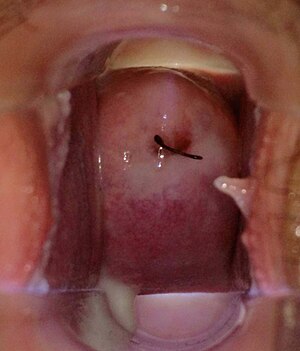 | |
| Normal vagina and neck during a medical speculum exam demonstrating IUD strings at the opening of the cervix and normal milky white vaginal discharge on the vaginal walls, cervix, and pooled in vaginal fornix. | |
| Specialty | Gynecology |
Vaginal discharge is a mixture of liquid, cells, and leaner that lubricate and protect the vagina.[1] This mixture is constantly produced by the cells of the vagina and cervix, and it exits the body through the vaginal opening. The composition, amount, and quality of discharge varies between individuals and can vary throughout the menstrual bicycle and throughout the stages of sexual and reproductive evolution.[2] Normal vaginal discharge may have a thin, watery consistency or a thick, pasty consistency, and it may be articulate or white in colour.[one] Normal vaginal discharge may be large in volume merely typically does not have a strong scent, nor is it typically associated with itching or hurting.[two] While most discharge is considered physiologic or represents normal functioning of the trunk, some changes in discharge tin reflect infection or other pathological processes.[3] [4] Infections that may crusade changes in vaginal discharge include vaginal yeast infections, bacterial vaginosis, and sexually transmitted infections.[5] The characteristics of abnormal vaginal discharge vary depending on the cause, only common features include a change in color, a foul scent, and associated symptoms such as itching, called-for, pelvic pain, or pain during sexual intercourse.[6]
Normal belch [edit]

Stretchy discharge around ovulation.

Thick belch around menstruum.
Normal vaginal discharge is composed of cervical mucus, vaginal fluid, shedding vaginal and cervical cells, and bacteria.[1]
The bulk of the liquid in vaginal discharge is mucus produced by glands of the cervix.[i] [3] The rest is made up of transudate from the vaginal walls and secretions from glands (Skene'due south and Bartholin's).[3] The solid components are exfoliated epithelial cells from the vaginal wall and cervix too as some of the leaner that inhabit the vagina.[1] These bacteria that live in the vagina exercise non typically crusade disease. In fact, they can protect the private from other infectious and invasive bacteria by producing substances such every bit lactic acid and hydrogen peroxide that inhibit growth of other leaner.[5] The normal composition of bacteria in the vagina (vaginal flora) can vary, but is most commonly dominated by lactobacilli.[i] On boilerplate, in that location are approximately x8 to tennine bacteria per milliliter of vaginal discharge.[1] [3]
Normal vaginal discharge is clear, white, or off-white.[i] The consistency tin can range from milky to clumpy, and odor typically mild to not-existent.[1] The majority of the discharge pools in the deepest portion of the vagina (the posterior fornix)[two] and exits the body over the class of a twenty-four hour period with the forcefulness of gravity.[1] [3] A typical reproductive-age woman produces 1.5 grams (half to one teaspoon) of vaginal belch every day.[one]
During sexual arousal and sexual intercourse, the amount of fluid in the vagina increases due to engorgement of blood vessels surrounding the vagina. This engorgement of blood vessels increases the volume of transudate from the vaginal walls.[iii] Transudate has a neutral pH, so increases in its production tin temporarily shift vaginal pH to exist more neutral.[iii] Semen has a basic pH and tin can neutralize the acerbity of the vagina for upwardly to 8 hrs.[3]
The composition and amount of vaginal discharge changes as an individual goes through the various stages of sexual and reproductive development.[3]
Neonatal [edit]
In neonates, vaginal discharge sometimes occurs in the offset few days after birth. This is due to exposure to estrogen while in utero. Neonatal vaginal discharge may be white or articulate with a mucous texture, or information technology may be bloody from normal transient shedding of the endometrium.[7]
Pediatric [edit]
The vagina of girls before puberty is thinner and has a different bacterial flora.[1] [3] Vaginal discharge in pre-pubertal girls is minimal with a neutral to element of group i pH ranging from half-dozen to 8.[8] The composition of the bacterial population in pre-pubertal girls is dominated by staphylococcus species, in addition to a range of anaerobes, enterococci, E. coli, and lactobacillus.[8]
Puberty [edit]
During puberty, the hormone estrogen begins to be produced by the ovaries.[ii] Even before the beginning of menses (up to 12 months before menarche, typically at the same time as the evolution of breast buds,[three]) vaginal discharge increases in amount and changes in composition.[8] Estrogen matures vaginal tissues and causes increased product of glycogen by epithelial cells of the vagina.[1] These higher levels of glycogen in the vaginal canal support the growth of lactobacilli over other bacterial species.[1] [2] When lactobacilli use glycogen every bit a food source, they convert information technology to lactic acid.[1] [ii] [iii] Therefore, the predominance of lactobacilli in the vaginal canal creates a more acidic environment. In fact, the pH of the vagina and vaginal discharge after puberty ranges between 3.5 and 4.vii.[1]
Menstrual bike [edit]
The amount and consistency of vaginal belch changes with the menstrual wheel.[9] In the days right afterwards menstruation, vaginal discharge is minimal, and its consistency is thick and viscid.[10] When approaching ovulation, the rising estrogen levels cause a concomitant increase in vaginal belch.[10] The corporeality of belch produced at ovulation is thirty times greater than the amount produced direct following flow.[10] The discharge besides changes in color and consistency during this time, condign articulate with an elastic consistency.[10] After ovulation the torso's progesterone levels increase, which causes a decrease in the amount of vaginal discharge.[10] The consistency of the belch one time once more becomes thick and sticky and opaque in color.[10] The belch continues to decrease from the end of ovulation until the end of flow, and then after flow it begins its rise over again.[10]
Pregnancy [edit]
During pregnancy, vaginal discharge volume increases as a effect of the body'due south increased levels of estrogen and progesterone.[11] The belch is usually white or slightly gray, and may have a musty scent.[11] The normal discharge of pregnancy does not comprise blood or cause itching.[11] The pH of the vaginal discharge in pregnancy tends to exist more than acidic than normal due to increased production of lactic acid.[eleven] This acidic surround helps to provide protection from many infections, though conversely it also makes women more than susceptible to vaginal yeast infections.[11]
Postpartum [edit]
Discharge may be ruddy and heavy for the showtime few days as it consists of blood and the superficial mucus membrane that lined the uterus during pregnancy. This belch normally begins to taper and should become more than watery and modify in color from pink brown to yellow white.[12]
Menopause [edit]
With the drop in estrogen levels that comes with menopause, the vagina returns to a state like to pre-puberty.[7] Specifically, the vaginal tissues thin, become less elastic; blood menstruum to the vagina decreases; the surface epithelial cells contain less glycogen.[7] With decreased levels of glycogen, the vaginal flora shifts to incorporate fewer lactobacilli, and the pH subsequently increases to a range of 6.0-seven.five.[vii] The overall corporeality of vaginal discharge decreases in menopause. While this is normal, it tin atomic number 82 to symptoms of dryness and pain during penetrative sexual intercourse.[13] These symptoms can often be treated with vaginal moisturizers/lubricants or vaginal hormone creams.[14]
Aberrant discharge [edit]
Abnormal discharge tin occur in a number of conditions, including infections and imbalances in vaginal flora or pH. Sometimes, aberrant vaginal discharge may not have a known cause. In i study looking at women presenting to dispensary with concerns about vaginal discharge or a foul smell in their vagina, it was institute that 34% had bacterial vaginosis and 23% had vaginal candidiasis (yeast infection).[half-dozen] 32% of patients were found to take sexually transmitted infections including Chlamydia, Gonorrhea, Trichomonas, or Genital Herpes.[6] Diagnosing the cause of abnormal vaginal belch can exist hard, though a potassium hydroxide test or vaginal pH analysis may exist used. When abnormal discharge occurs with called-for, irritation, or itching on the vulva, it is called vaginitis.[vii]
It is important to seek care when abnormal vaginal discharge or changes to vaginal discharge are noticed. Associated symptoms with pathological causes of vaginal discharge include: itching of the outside ballocks, irritation or inflammation of the external ballocks, green or foam-similar discharge, bloody discharge non associated with flow, dissimilar odors, new or worsening pain associated with the discharge, or pain with sex activity or urination.[15] Cocky-treatment is not recommended and can worsen symptoms.[16]
Upon the diagnosis of vaginitis, a speculum exam is performed to evaluate the vagina, vaginal discharge, and the cervix. The doc will insert the speculum into the vagina while the patient lies on their back to exam for foreign bodies, vaginal warts, inflammation, as well equally rashes/bruises. A sample of the vaginal discharge is then collected using a cotton-swab and tested for pH and under microscopy.[17] The nearly common causes of pathological vaginal discharge in adolescents and adults are described below.[ citation needed ]
Prevention of Abnormal belch [edit]
Certain steps can be taken to avoid vaginal irritation and infection that can lead to pathological causes of vaginal discharge. When cleaning the vulva, use warm water and avoid scented cleansers and bath products. Avoid sprays, powders, baby wipes, scented toilet paper and douches. [18]
Bacterial vaginosis [edit]
Bacterial vaginosis (BV) is an infection caused by a alter in the vaginal flora, which refers to the customs of organisms that alive in the vagina.[19] It is the most common cause of pathological vaginal discharge in women of childbearing age and accounts for forty–50% of cases.[20] In BV, the vagina experiences a decrease in a bacterium called lactobacilli, and a relative increase in a multitude of anaerobic leaner with the most predominant being Gardnerella vaginalis.[21] This imbalance results in the characteristic vaginal discharge experienced by patients with BV.[xix] The discharge in BV has a feature potent fishy aroma, which is caused past the relative increment in anaerobic leaner.[1] The discharge is typically sparse and grey, or occasionally green.[19] [21] It sometimes is accompanied past burning with urination. Itching is rare.[22] The exact reasons for the disruption of vaginal flora leading to BV are not fully known.[23] Yet, factors associated with BV include antibiotic utilize, unprotected sex, douching, and using an intrauterine device (IUD).[24] The role of sex in BV is unknown, and BV is not considered an STI.[xix] The diagnosis of BV is made by a health intendance provider based on the advent of the discharge, discharge pH > 4.5, presence of inkling cells, when viewing the collected discharge from speculum exam under the microscope, and a characteristic fishy olfactory property when the discharge is placed on a slide and combined with potassium hydroxide ("whiff test").[nineteen] [21] The gold standard for diagnosis is a gram stain showing a relative lack of lactobacilli and a polymicrobial assortment of gram negative rods, gram variable rods, and cocci. BV may be treated with oral or intravaginal antibiotics, such equally metronidazole,[25] or lactobacillus.[26]
Vaginal yeast infection [edit]
A vaginal yeast infection or vaginal candidiasis results from overgrowth of candida albicans, or yeast, in the vagina.[27] This is a relatively mutual infection, with over 75% of women having experienced at least one yeast infection at some point in their life.[28] Risk factors for yeast infections include recent antibiotic employ, diabetes mellitus, immunosuppression, increased estrogen levels, and use of certain contraceptive devices including intrauterine devices, diaphragms, or sponges.[27] [29] It is not a sexually transmitted infection. Candida vaginal infections are common; an estimated 75% of women volition accept at to the lowest degree one yeast infection in their lifetime.[29] Vaginal belch is not always present in yeast infections, but when occurring it is typically odorless, thick, white, and clumpy.[27] Vaginal itching is the nearly common symptom of candida vulvovaginitis.[27] Women may likewise feel burning, soreness, irritation, pain during urination, or pain during sex.[29] The diagnosis of Candida vulvovaginitis is made by looking at a sample taken during speculum exam under the microscope that shows hyphae (yeast), or from a civilization.[30] It is important to note that the symptoms described above may be present in other vaginal infections, so microscopic diagnosis or civilization is needed to ostend the diagnosis.[29] Handling is with intra-vaginal or oral anti-fungal medications.[29]
Trichomonas vaginitis [edit]
Trichomonas vaginitis is an infection acquired through sex that is associated with vaginal discharge.[27] It can exist transmitted by way of the penis to the vagina, the vagina to the penis, or from vagina to vagina.[31] The belch in Trichomonas is typically yellowish-green in color.[27] Information technology sometimes is frothy and tin accept a foul olfactory property.[32] Other symptoms may include vaginal burning or itching, hurting with urination, or hurting with sexual intercourse.[31] Trichomonas is diagnosed past looking at a sample of discharge under the microscope showing trichomonads moving on the slide.[27] Yet, in women with trichomonas the organism is typically detected in only sixty-eighty% of cases.[27] Other testing, including a culture of the discharge or a PCR assay, are more probable to notice the organism.[27] Treatment is with a i fourth dimension dose of oral antibiotics, most commonly metronidazole or tinidazole.[27]
Chlamydia and gonorrhea [edit]
Chlamydia and gonorrhea can too cause vaginal belch, though by and large these infections do not cause symptoms.[32] The vaginal discharge in Chlamydia is typically pus-filled, but information technology is important to notation that in around 80% of cases Chlamydia does not cause any discharge.[32] Gonorrhea tin can also crusade pus-filled vaginal belch, merely Gonorrhea is similarly asymptomatic in upwardly to 50% of cases.[32] If the vaginal belch is accompanied by pelvic pain, this is suggestive of pelvic inflammatory disease (PID), a status in which the bacteria accept moved up the reproductive tract.[32]
Other causes [edit]
Foreign objects tin cause a chronic vaginal discharge with a foul odour.[33] Common foreign objects found in adolescents and adults are tampons, toilet newspaper, and objects used for sexual arousal.[33]
Before puberty [edit]
The most common reason pre-pubertal females go to the gynecologist is business organisation virtually vaginal belch and vaginal aroma.[34] The causes of abnormal vaginal discharge in pre-pubertal girls are different than in adults and are usually related to lifestyle factors such as irritation from harsh soaps or tight wearable.[34] The vagina of pre-pubertal girls (due to lack of estrogen) is thin-walled and has a different microbiota; additionally, the vulva in pre-pubertal girls lacks pubic hair. These features makes the vagina more prone to bacterial infection.[34] The bacteria that are more commonly responsible for vaginal discharge in pre-pubertal girls are distinct from those in other historic period groups, and include Bacteroides, Peptostreptococcus, and Candida (yeast). These can derive from the colonization of the vagina with oral or fecal leaner.[35] Some other cause of vaginal discharge in pre-pubertal girls is the presence of a strange object such as a toy or a piece of toilet newspaper.[33] In the case of a foreign body, the discharge is oftentimes bloody or brownish.[33]
See also [edit]
- Bartholin'south gland
- Semen
- Vaginal flora
- Vaginal lubrication
- Vaginal microbiota in pregnancy
References [edit]
- ^ a b c d e f g h i j k l thousand n o p Beckmann, R.B. (2014). Obstetrics and Gynecology (7th ed.). Baltimore, Dr.: Lippincott Williams & Wilkins. p. 260. ISBN9781451144314.
- ^ a b c d e f Hacker, Neville F. (2016). Hacker & Moore's Essentials of Obstetrics and Gynecology (6th ed.). Philadelphia, PA: Elsevier. p. 276. ISBN9781455775583.
- ^ a b c d e f g h i j one thousand l Lentz, Gretchen Chiliad. (2012). Comprehensive Gynecology (6th ed.). Philadelphia, PA: Elsevier. pp. 532–533. ISBN9780323069861.
- ^ LeBlond, Richard F. (2015). "Affiliate 11". DeGowin'south Diagnostic Exam (10th ed.). McGraw-Colina Education. ISBN9780071814478.
- ^ a b Rice, Alexandra (2016). "Vaginal Discharge". Obstetrics, Gynaecology & Reproductive Medicine. 26 (11): 317–323. doi:10.1016/j.ogrm.2016.08.002.
- ^ a b c Wathne, Bjarne; Holst, Elisabeth; Hovelius, Birgitta; Mårdh, Per-Anders (1994-01-01). "Vaginal belch - comparison of clinical, laboratory and microbiological findings". Acta Obstetricia et Gynecologica Scandinavica. 73 (10): 802–808. doi:10.3109/00016349409072509. ISSN 0001-6349. PMID 7817733. S2CID 26037589.
- ^ a b c d e Hoffman, Barbara; Schorge, John; Schaffer, Joseph; Halvorson, Lisa; Bradshaw, Karen; Cunningham, F. (2012-04-12). Williams Gynecology, Second Edition. McGraw Colina Professional. ISBN9780071716727.
- ^ a b c Adams, Hillard, Paula. Practical pediatric and adolescent gynecology. OCLC 841907353.
- ^ "Age 25 - Entire Cycle | Cute Cervix Project". beautifulcervix.com. 2008-12-06. Retrieved 2016-12-sixteen .
- ^ a b c d eastward f grand Reed, Beverly One thousand.; Carr, Bruce R. (2000-01-01). "The Normal Menstrual Cycle and the Command of Ovulation". In De Groot, Leslie J.; Chrousos, George; Dungan, Kathleen; Feingold, Kenneth R.; Grossman, Ashley; Hershman, Jerome M.; Koch, Christian; Korbonits, Márta; McLachlan, Robert (eds.). Endotext. S Dartmouth (MA): MDText.com, Inc. PMID 25905282.
- ^ a b c d e Leonard., Lowdermilk, Deitra; E., Perry, Shannon (2006-01-01). Maternity nursing. Mosby Elsevier. OCLC 62759362.
- ^ "Postpartum care: Afterwards a vaginal delivery". Mayo Clinic . Retrieved 2021-09-twenty .
- ^ 1918-2006., Hairdresser, Hugh R. One thousand. (1988-01-01). Perimenopausal and geriatric gynecology. Macmillan. OCLC 17227383.
{{cite book}}: CS1 maint: numeric names: authors list (link) - ^ I., Sokol, Andrew; R., Sokol, Eric (2007-01-01). General gynecology: the requisites in obstetrics and gynecology. Mosby. OCLC 324995697.
- ^ "UpToDate". www.uptodate.com . Retrieved 2021-09-xx .
- ^ "UpToDate". www.uptodate.com . Retrieved 2021-09-xiii .
- ^ "UpToDate". www.uptodate.com . Retrieved 2021-09-13 .
- ^ "UpToDate". www.uptodate.com . Retrieved 2021-09-13 .
- ^ a b c d east Alan H. DeCherney; et al. (2012). Current diagnosis & treatment: obstetrics & gynecology (11th ed.). Stamford, Conn.: Appleton & Lange. ISBN978-0071638562.
- ^ "CDC - Bacterial Vaginosis Statistics". www.cdc.gov . Retrieved 2016-12-16 .
- ^ a b c Keane F, Ison CA, Noble H, Estcourt C (December 2006). "Bacterial vaginosis". Sex Transm Infect. 82 Suppl 4: iv16–8. doi:ten.1136/sti.2006.023119. PMC2563898. PMID 17151045.
- ^ "What are the symptoms of bacterial vaginosis?". www.nichd.nih.gov.
- ^ "STD Facts - Bacterial Vaginosis". www.cdc.gov. 2019-01-11.
- ^ "What causes bacterial vaginosis (BV)?". www.nichd.nih.gov.
- ^ "UpToDate". www.uptodate.com . Retrieved 2021-09-13 .
- ^ Oduyebo, Oyinlola O.; Anorlu, Rose I.; Ogunsola, Folasade T. (2009). "The effects of antimicrobial treatment on bacterial vaginosis in not-pregnant women | Cochrane". Cochrane Database of Systematic Reviews (iii): CD006055. doi:10.1002/14651858.CD006055.pub2. PMID 19588379.
- ^ a b c d e f m h i j Usatine R, Smith MA, Mayeaux EJ, Chumley H (2013-04-23). Color Atlas of Family Medicine (2nd ed.). New York: McGraw Loma. ISBN978-0071769648.
- ^ "Genital / vulvovaginal candidiasis (VVC) | Fungal Diseases | CDC". www.cdc.gov . Retrieved 2016-12-16 .
- ^ a b c d e Barry L. Hainer; Maria V. Gibson (April 2011). "Vaginitis: Diagnosis and Treatment". American Family Doc. 83 (7): 807–815.
- ^ "Vulvovaginal Candidiasis - 2015 STD Treatment Guidelines". www.cdc.gov. 2019-01-xi.
- ^ a b "STD Facts - Trichomoniasis". www.cdc.gov . Retrieved 2016-12-04 .
- ^ a b c d e Spence, Des; Melville, Catriona (2007-12-01). "Vaginal belch". BMJ: British Medical Journal. 335 (7630): 1147–1151. doi:ten.1136/bmj.39378.633287.fourscore. ISSN 0959-8138. PMC2099568. PMID 18048541.
- ^ a b c d E., Tintinalli, Judith; Stephan., Stapczynski, J. (2011-01-01). Tintinalli'south emergency medicine : a comprehensive study guide. McGraw-Hill. OCLC 646388436.
- ^ a b c Herriot., Emans, S. Jean; R., Laufer, Marc (2011-01-01). Emans, Laufer, Goldstein's pediatric & adolescent gynecology. Wolters Kluwer Wellness/Lippincott Williams & Wilkins Health. OCLC 751738201.
- ^ Rome ES (2012). "Vulvovaginitis and other common vulvar disorders in children". Pediatric and Adolescent Gynecology. Endocr Dev. Endocrine Evolution. Vol. 22. pp. 72–83. doi:10.1159/000326634. ISBN978-3-8055-9336-6. PMID 22846522.
External links [edit]
jeffersonfroys1972.blogspot.com
Source: https://en.wikipedia.org/wiki/Vaginal_discharge
0 Response to "Yellow Dishcarhe in a 1 Week Old Girl Baby"
Post a Comment