Hydroponic Garden: Everything You Need to Know | The Family Handyman
Every editorial product is independently selected, though we may exist compensated or receive an affiliate commission if you buy something through our links. Ratings and prices are accurate and items are in stock every bit of time of publication.
With impressive yields and efficient use of infinite, hydroponics may be the future of horticulture. Here'southward an overview of at-home hydroponic gardening.
The world's population continues to grow, while the amount of arable state and fresh water available to produce sufficient food for billions of people is beginning to top out. 1 solution is hydroponic agronomics. This soil-less farming requires little infinite and water, can be done indoors or outdoors, and turns out much higher yields than traditional farming methods.
"Hydroponics is undoubtedly considered an approach to the future of agriculture," says gardening author and horticulturist Brie Arthur. "In a world where scientists are working to solve the matters of nutrient and natural resources in a sustainable and ecological way, hydroponics will play a major role."
Next-generation hydroponic farming has captured the attention of everyone from developing nations to NASA engineers, merely it besides has a growing following among home gardeners. The benefits of reduced water and space requirements, plus increased yields, are attractive whether you're trying to feed a nation, astronauts on Mars or your family.
Hither's what you need to know nearly hydroponic gardening.
What Is a Hydroponic Garden?
"Hydroponics is a type of horticulture and a subset of hydroculture, which is a method of growing plants without soil by using mineral nutrient solutions in an aqueous solvent," Arthur says. "Terrestrial plants may be grown with only their roots exposed to the nutritious liquid or the roots may be physically supported by an inert medium such as perlite, gravel or other substrates."
Simply put, instead of growing plants in a bed of soil, you plant them in a structure that suspends their roots in a full-bodied solution of water and nutrients. Pumps circulate the nutrient solution past the roots to maximize absorption.
Plants grown this way only need to develop a modest number of gristly roots rather than an extensive root system to become the water and nutrients they need. This turbo-boosts their growing power, allows you to plant more densely and, in the case of an indoor hydroponic garden, permits twelvemonth-round gardening.
How Is a Hydroponic Garden Different from a Traditional Garden?
-
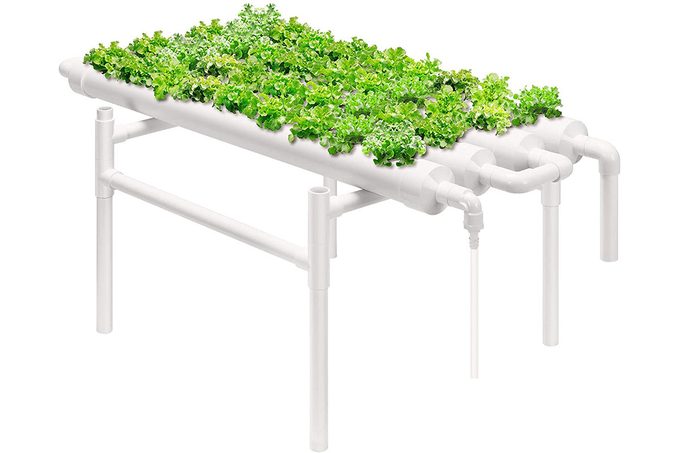
Hydroponic gardens practice not crave soil. Traditional gardens are planted directly in the ground, in raised beds or in soil-filled containers. Hydroponic gardens are planted in a water-based hydroponic system, which comes in various shapes and styles from simple bucket systems to tiers or tables.
-
Because their water supply is circulated through the system a number of times earlier it's discarded, hydroponic gardens require significantly less water than traditional gardens. Where traditional gardens lose much of their h2o supply to drainage or evaporation, hydroponic garden systems allows for little water dispersion.
-
With supplemental lighting, hydroponic gardens can be cultivated indoors. Traditional gardens rely on sunlight for their plants' photosynthesis requirements. Hydroponic gardens can survive under special grow lights, even indoors. "Any location with sufficient lite and admission to electricity is an opportunity waiting to happen," says Arthur.
-
Tier or shelf hydroponic systems allow y'all to abound the aforementioned number of plants as a traditional garden in a fraction of the space. Outdoor plants need plenty of room to expand their root systems and capture enough sunlight. The nutrient-rich solution in hydroponic gardening (and supplemental lighting indoors) ensures that plants get the macro- and micronutrients they demand even when densely spaced.
-
Hydroponic gardens have no weeds and dramatically fewer pests and diseases. What pests and diseases you practise encounter are easier to manage organically, co-ordinate to Arthur.
-
Indoor hydroponic gardens can be cultivated all twelvemonth circular. Except in the most temperate growing zones in the U.S., traditional outdoor gardens have an annual growing season.
-
Hydroponic gardens require a solution of macro- and micronutrients specially formulated for this type of soil-less agriculture. "Micronutrients are needed in small quantities only are as important equally macronutrients," explains Arthur. "Most fertilizers for soil-based growing focus on the macronutrients and don't include micronutrients, since information technology's assumed these will come from the soil and other amendments."
Pros and Cons of Hydroponic Gardens
In that location are many benefits to hydroponic gardens, merely also a few drawbacks. Consider both earlier taking the plunge:
Pros
- High yields. Arthur notes that the world record holder for well-nigh ripe tomatoes at in one case on i hydroponic lycopersicon esculentum is 32,000. That would be difficult to beat with a single love apple institute in your backyard!
- Limited water requirements.
- Express space requirements.
- Consummate control over the surround (in the case of an indoor hydroponic garden).
- Option of gardening indoors for a 12-month growing season.
- Petty maintenance needed once the system is upwards and running.
- A science-focused project that can include the whole family. "My mechanically inclined married man is intrigued by the pumps and electrical systems that traditional gardens don't offer," says Arthur, "while my son enjoys mixing and applying the food solutions to run into how the plants react."
Cons
- Initial setup costs can be loftier, especially for a larger garden. Indoor systems also require abound lights and fans for ventilation.
- Not all plants take well to hydroponic techniques, including root vegetables.
- It volition have time to larn the ins and outs of your organization, understand the nutrients your plants need, become on height of the water changes, and adopt a addiction of monitoring your plants and their surroundings for optimal growth.
- There is little leeway for equipment failure or mistakes. If a water pump goes out or you lot make an fault calculating the nutrient solution or water modify, your entire garden can die in hours.
Starting a Hydroponic Garden
- The first step when starting a hydroponic garden is deciding what kind of plants to grow, and how many. Sure plants thrive with specific hydroponic methods, then match the type and size of the arrangement to the type and number of plants. Arthur suggests starting off with like shooting fish in a barrel plant options like leafy greens, tomatoes, cucumbers and basil or other herbs.
- And so choose the blazon of hydroponic system. You lot can build a DIY version with divide parts or purchase a kit. According to Arthur, the most popular habitation hydroponic setups are deep-water submersion, drip and ebb-and-flow.
- Accept fourth dimension to get to know how your arrangement works and larn the right food solution for your specific plants. At that place can exist a steep learning curve when you start a hydroponic garden, and then practise inquiry ahead of time to decrease the margin of error.
- Plant your garden and begin monitoring the h2o (pH and nutrient levels), surround (temperature, light and humidity) and plants (burns, affliction or pests) carefully for at to the lowest degree a few weeks until you start to get the hang of it. An indoor hydroponic garden is easier to control than an outdoor 1, notes Arthur, so beginners may desire to start off with an indoor setup.
Finally, stand back and watch your garden grow!
jeffersonfroys1972.blogspot.com
Source: https://www.familyhandyman.com/article/hydroponic-garden/
0 Response to "Hydroponic Garden: Everything You Need to Know | The Family Handyman"
Post a Comment